
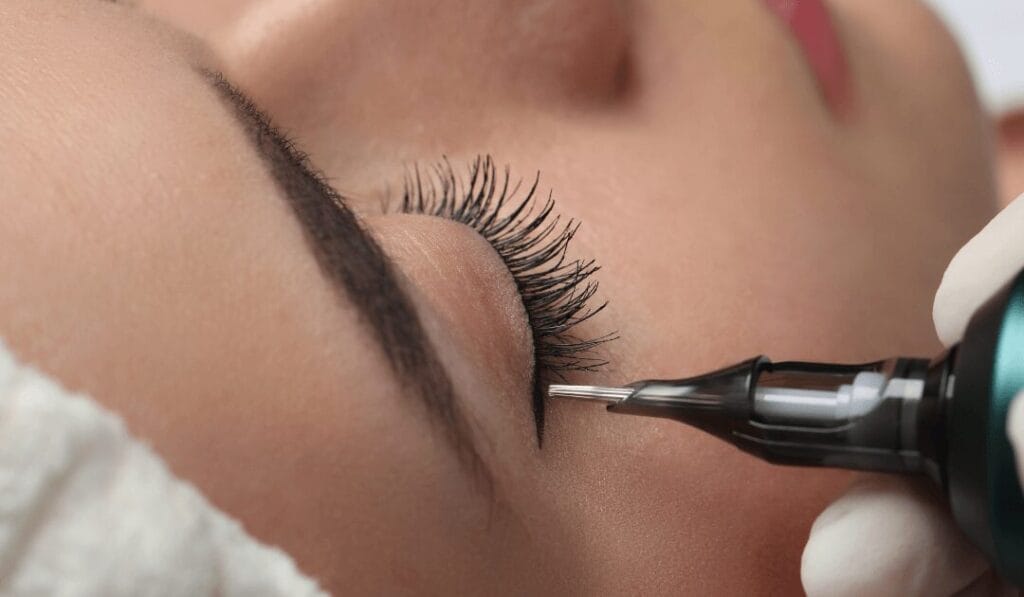
What Does a Permanent Makeup Artist Do?
A permanent makeup artist (PMU artist) performs cosmetic tattooing—also called micropigmentation—to enhance or restore features like eyebrows, lips, and eyeliner. The job includes client consultations, facial mapping, pigment selection, sterile setup, precise machine work, and detailed aftercare guidance. Many artists also provide corrective work and medical tattooing such as scar camouflage or areola restoration.
A career as a permanent makeup artist is a unique blend of artistry, precision, and technical skill. These professionals specialize in enhancing their clients’ natural beauty by using cosmetic tattooing techniques to create long-lasting results. Whether it’s defining eyebrows with Ombré Powder Brows, enhancing lips with Lip Blush, or camouflaging scars, permanent makeup artists transform appearances and boost confidence.
This guide breaks down what the role looks like in real life—services, workflow, tools, safety standards, training and licensing, and what both clients and aspiring artists should know before booking or building a career.
Permanent makeup artist responsibilities (what the job actually includes)
Permanent makeup artists implant pigment into the upper layers of skin to create enhancements that resemble makeup—or natural features. In practice, the job is far broader than “doing brows.” It includes intake and consent, design and mapping, pigment selection, comfort management, the procedure itself, and aftercare plus follow-up.
A typical day can involve new clients, touch-ups, color boosts, and corrective work (fixing shape, color, or uneven saturation from previous treatments). Artists also spend meaningful time on non-procedure tasks—sanitation, inventory, documentation, content/marketing, and client communication—because trust and safety drive referrals and long-term success.
What separates a true professional from a hobbyist is decision-making: choosing the right technique for the client’s skin, working at a safe depth, and knowing when to postpone, refuse, or refer. PMU is “small-area tattooing,” but the stakes are high because it’s on the face and clients see it daily.
Key services PMU artists provide (and what each one is meant to achieve)
Permanent makeup isn’t one service—it’s a category with different goals, tools, and healing behaviors. Brows, lips, and eyeliner each have unique risks and retention patterns, and an experienced artist explains those trade-offs before the client commits. The best outcomes usually come from conservative design that complements the client’s features rather than chasing a trend.
Many studios also offer restorative and corrective services. These can be life-changing, but they require extra skill: scar tissue behaves differently than normal skin, and old pigment may need removal before it can be safely corrected. A responsible PMU artist treats “fixing” work as a separate specialty, not an add-on.
- Ombré Powder Brows: Soft, gradient shading for a polished, makeup-like brow that can heal more evenly across many skin types.
- Lip Blush: A sheer tint and shape enhancement that improves symmetry and adds a healthy-looking tone.
- Eyeliner Tattooing: Defined eyes ranging from subtle lash enhancement to a more noticeable liner (usually best kept conservative for aging).
- Scar Camouflage: Skin-toned blending to reduce the contrast of stable, healed scars.
- Areola Restoration: Natural shading and dimension after reconstruction, often in collaboration with medical teams.
- Scalp Micropigmentation: A follicle “stubble/density” illusion using dot patterns matched to hair and skin tone.
Even within one category (like brows), there are multiple approaches: hair-stroke styles, pixel shading, combination brows, and different machine techniques. A good artist chooses the method that will heal predictably for that individual—then explains why.
Client consultations: mapping, expectations, and contraindications
Consultation is where most successful PMU outcomes are won or lost. The artist assesses face shape, natural hair growth, undertone, skin type, and lifestyle factors that affect retention (sun exposure, skincare actives, sweating, swimming). They also clarify the client’s desired look using realistic references—ideally healed examples, not heavily filtered photos.
Strong consultations include medical history screening and a clear explanation of contraindications. Examples include active skin infections, compromised healing, certain medications, recent cosmetic procedures in the area, and conditions that increase risk of scarring. For lip procedures, a history of cold sores matters; many clients need to speak with a physician about antiviral prophylaxis based on their history and local practice norms.
Mapping and pre-draw are not “quick sketches.” They’re proportion work: balancing brow height, tail length, arch placement, and spacing so the design fits the client’s bone structure and natural asymmetry. A professional artist builds in time for client feedback, because approval before pigment goes in is part of informed consent.
A day in the life: workflow from consult to aftercare
Most appointments follow a repeatable workflow designed for safety and consistency. The day often starts with preparation: disinfecting surfaces, setting up a barrier-protected workstation, preparing single-use supplies, and confirming pigment batch integrity and expiration dates. Many artists review client notes in advance to plan timing, technique, and any special considerations.
During the appointment, time is split between design and execution. Mapping and pre-draw can take as long as the procedure itself because symmetry and client approval matter. The procedure then involves controlled passes, consistent skin stretch, and frequent checks under stable lighting to avoid overworking tissue.
After the procedure, the artist photographs the work, documents pigment formulas and needle configurations, and provides written aftercare instructions. Follow-up is built into quality PMU: many services are designed as a two-step process (initial session plus a perfecting session), and long-term maintenance often includes periodic color boosts depending on skin and lifestyle.
Behind the scenes, there’s also admin work: answering healing questions, managing reschedules, ordering supplies, updating consent forms, and maintaining sanitation logs. The most booked artists tend to be the most organized, not just the most “artistic.”
Tools, pigments, and techniques (and why they matter)
A professional permanent makeup artist works with a tight set of variables: device type (machine vs. manual tool), needle configuration, speed/voltage, hand pressure, pigment choice, and skin stretch. Small differences can dramatically change how a result heals—especially on thin eyelid skin or vascular lip tissue.
Pigments are not “one color fits all.” Artists adjust for undertone, Fitzpatrick skin type, and desired healed intensity, and they consider how pigments shift as they fade. For example, some brow pigments can heal cooler or warmer depending on skin chemistry and depth, which is why conservative color choices and clear expectation-setting matter.
Technique selection is equally important. Ombré Powder Brows rely on pixelated shading and layering for a soft gradient, while hair-stroke techniques aim for crisp lines that mimic hair. Lip blush typically requires a gentle, buildable approach to avoid excessive trauma and swelling. A skilled artist chooses the least traumatic method that still achieves the goal and will age well.
Skills required to succeed as a permanent makeup artist
Becoming a successful PMU artist requires more than steady hands. You can learn the mechanics of a machine, but long-term success depends on judgment—knowing how skin will heal, how to avoid overworking tissue, and how to communicate clearly when a client’s request isn’t realistic.
It’s also a service business. Artists who thrive are consistent, calm under pressure, and excellent at setting expectations. They build trust by explaining the process, showing sanitation standards without being asked, and being transparent about healing, touch-ups, and maintenance.
- Artistic ability: A strong eye for symmetry, proportion, and natural enhancement.
- Color theory: Understanding undertones and how pigments fade or shift over time.
- Skin knowledge: Recognizing how oiliness, pore size, elasticity, and scar tissue affect retention.
- Precision and tissue control: Safe depth, consistent pressure, and avoiding overworking.
- Client communication: Setting expectations, obtaining informed consent, and guiding aftercare.
- Hygiene discipline: Treating sanitation as non-negotiable, every client, every time.
Two underrated skills are documentation and time management. Recording pigment mixes, needle types, machine settings, and healing notes makes touch-ups more predictable and helps you troubleshoot retention issues. And rushing mapping or aftercare explanations is one of the fastest ways to create unhappy clients—even when the technical work is good.
Safety, hygiene, and regulations (what “professional” should look like)
Permanent makeup is a form of tattooing, so safety standards should be comparable to high-quality tattoo studios—plus the added sensitivity of working on faces. Professional practice includes medical-grade disinfectants, barrier film on high-touch surfaces, single-use needles and disposables, and strict hand hygiene. Clients should see a clean setup and also hear a clear explanation of how cross-contamination is prevented.
Beyond a clean-looking studio, safety means correct barrier protection, single-use pigment cups, proper sharps disposal, and documented cleaning routines. It also means knowing when to say “not today”—for example, if a client arrives with an active cold sore for lip work, fresh sunburn, or signs of infection near the treatment area.
Regulations vary by region, but clients should expect informed consent, aftercare instructions, and screening for contraindications. Many jurisdictions require bloodborne pathogens training and licensing, and some require inspections. For a baseline overview of safety considerations around tattoos and permanent makeup, see the FDA resource here: licensed or certified.
If an artist can’t clearly explain their sanitation process, refuses to discuss patch testing or contraindications, or downplays risks, that’s not “relaxed vibes”—it’s a red flag.
Client suitability: who is (and isn’t) a good candidate
Good candidates are typically healthy adults who want to enhance features, simplify routines, or restore appearance after medical events. Ideal clients understand that PMU is a process: there’s healing, there may be a perfecting session, and results fade gradually. They’re also willing to follow aftercare instructions closely.
Not everyone is a suitable candidate on the day of treatment. Active skin infections, fresh sunburn, recent aggressive exfoliation, or certain uncontrolled medical conditions may require postponement. Pregnancy and nursing policies vary by provider and jurisdiction; a professional studio will have a clear policy and explain it upfront rather than improvising.
Suitability is also about expectations. If a client wants a heavy, high-contrast makeup look that “never fades,” a responsible artist will explain why that can age poorly and why softer work is usually safer and more flattering long-term. Sometimes the best service is a referral to a different option (like makeup, tinting, or removal first).
Healing, touch-ups, and long-term maintenance (what clients should expect)
Healing is not just “wait a week.” Brows and eyeliner commonly go through stages: initial darkness, flaking/lightening as the surface heals, and then a gradual return of pigment as the skin settles. Lips can swell, look brighter than expected, peel, and appear patchy before evening out. Artists should explain what’s normal and what requires medical attention (excessive heat, pus, spreading redness, fever).
Most services are designed with a follow-up perfecting appointment—often several weeks after the initial session—because the first session establishes shape and base color, and the second refines saturation and symmetry. Long-term, many clients choose a color boost every 12–36 months for brows and often every 2–4 years for lip blush, though results vary widely by skin and lifestyle.
Maintenance is also about daily habits. Sunscreen, avoiding aggressive exfoliation near treated areas, and being cautious with retinoids and acids can extend results. Clients who regularly use chemical peels or strong actives around brows should expect faster fading and plan their maintenance schedule accordingly.
Common misconceptions and costly mistakes (for clients and new artists)
One of the biggest misunderstandings is in the name: “permanent makeup” is usually semi-permanent. The goal is a soft enhancement that fades gradually and can be refreshed—not a harsh look that stays identical for years. When clients demand “as dark as possible so it lasts,” they often end up with results that age poorly and are harder to correct.
Another misconception is judging results too early. Fresh work is not healed work: brows look sharper and darker right away, lips look brighter and can be swollen, and eyeliner can look thicker during initial inflammation. Clients who panic in the first 48 hours sometimes over-clean, over-apply ointments, or pick at flakes—leading to patchiness and uneven retention.
For new artists, a common mistake is overworking tissue to “force” pigment to stay. Overworking increases trauma, prolongs healing, and can cause scarring or color issues. Another is relying on fresh photos for marketing—healed outcomes and consistent documentation are what build a serious reputation and reduce corrective cases.
Corrective work is also frequently misunderstood. Not all “bad work” can be fixed by adding more pigment; sometimes removal (laser or saline) is the safest first step. Ethical artists say this clearly, even if it means losing a booking.
How to become a permanent makeup artist (training, licensing, and real practice)
Most permanent makeup artists complete a specialized training program or certification in micropigmentation. Strong programs cover technique, color theory, skin anatomy, contraindications, and sanitation—not just how to create a trendy shape. Look for training that includes supervised hands-on practice and guidance on healed results, because PMU success is judged weeks later, not when the client leaves the chair.
Many regions require artists to be licensed or certified, often including bloodborne pathogens training and compliance with local health department rules. Because requirements vary widely, aspiring artists should confirm details with their local licensing board and budget for permits, inspections, CPR/first-aid (if recommended or required), and professional insurance.
Gaining experience is crucial. Many new artists build skill through apprenticeship or supervised models, documenting every case and tracking healed outcomes. Early on, focus on consistency over volume: fewer clients with better planning and follow-up will build your portfolio faster than rushing through appointments.
If you’re preparing for interviews in beauty or client-facing roles, you may also find these resources useful: esthetician interview questions, hair stylist interview questions, and makeup artist interview questions.
Career opportunities and work settings for permanent makeup artists
The field offers multiple paths depending on your interests and risk tolerance. Some artists prefer the structure and foot traffic of a salon; others want the autonomy of a private studio. Medical and restorative work can be especially meaningful, but it often comes with higher documentation standards and coordination with clinical teams.
Where you work also affects your schedule and the types of clients you attract. A studio that specializes in high-end cosmetic brows may have different expectations than a clinic that receives post-surgical referrals. Understanding these differences helps you choose training, build a portfolio, and set pricing that matches the market.
- Salons and beauty clinics: Built-in exposure and cross-referrals, sometimes less control over policies and pricing.
- Medical practices: Dermatology or plastic surgery settings for scar camouflage and areola restoration, often with stricter protocols.
- Independent studios: Maximum autonomy, but you manage marketing, accounting, compliance, and client experience end-to-end.
- Training institutes: Experienced artists may teach and mentor, which requires strong fundamentals and documented results.
Many artists build hybrid careers: part-time services while training, then transitioning to a private studio; or combining cosmetic PMU with a specialization like scar camouflage. If you’re exploring adjacent roles and how they differ day-to-day, you might also like what does an esthetician do and what does a hair stylist do.
Business realities: pricing, scheduling, client retention, and ethics
Permanent makeup is both a craft and a business. Your income is influenced by more than technique: consultation quality, cancellation policies, rebooking systems, and how you handle touch-ups all matter. Many artists underestimate the true time per appointment when they start—especially for mapping, consent, and aftercare education.
Client retention is built through consistency and honest communication. Clients return (and refer) when healed results match expectations, when policies are clear, and when follow-up feels organized. A predictable client journey helps: pre-care instructions, reminders, a check-in during healing, and an easy process for booking the perfecting session.
Ethics are a competitive advantage in PMU. Overpromising, copying another artist’s shapes without considering the client’s anatomy, or taking on corrective cases beyond your skill level can damage your reputation quickly. A professional permanent makeup artist knows when to refer out, when to recommend removal first, and when to say no.
It’s also worth remembering that “good business” includes safety: cutting corners on disposables, rushing sanitation, or skipping thorough consent might save minutes, but it can create outcomes that cost years of trust.
Service comparison table: purpose, best candidates, and upkeep
Clients often ask which service is “best,” but the right choice depends on goals, skin type, and tolerance for maintenance. This comparison is a practical starting point for questions to ask during a consultation, not a substitute for individualized assessment.
| Service | Main goal | Typical look | Best for | Common considerations | Maintenance expectation |
|---|---|---|---|---|---|
| Ombré Powder Brows | Define and fill brows | Soft gradient, makeup-like | Most skin types, especially combination/oily | Color choice must match undertone; avoid over-dark fronts | Boost every 1–3 years (varies widely) |
| Hair-stroke brows (machine or manual) | Mimic brow hairs | Fine strokes, natural | Normal/drier skin with finer pores | Strokes can blur faster on oily skin; requires conservative design | May need earlier refresh to keep strokes crisp |
| Lip Blush | Enhance lip color and shape | Soft tint, improved symmetry | Clients wanting subtle color without lipstick | Swelling and peeling are normal; cold sore history matters | Boost every 2–4 years (often) |
| Eyeliner / Lash enhancement | Define lash line | From subtle to bold | Clients wanting daily definition | Delicate skin; conservative thickness tends to age best | Touch-up as needed; may last longer than brows |
| Scar camouflage | Reduce scar visibility | Blended skin-tone effect | Stable, healed scars | Not for keloid-prone or immature scars; color matching is complex | May require multiple sessions; gradual adjustments |
| Areola restoration | Restore areola appearance | Natural shading and dimension | Post-reconstruction clients | Requires sensitivity, consent, and sometimes medical collaboration | Periodic refresh depending on skin and healing |
| Scalp micropigmentation | Create hair follicle illusion | Stubble/density effect | Hair loss or thinning areas | Dot size, spacing, and tone must match hair and skin | Often multi-session; refresh over time |
Use the table to guide your consultation questions: What will this look like healed? What does it look like after 12–24 months? What is the studio’s plan if retention is uneven after the first session?
The popularity of Ombré Powder Brows and Lip Blush
Among the many services offered by permanent makeup artists, Ombré Powder Brows and Lip Blush are two of the most in-demand treatments. They’re popular because they deliver visible improvement without looking overly “done” when executed well, and they fit modern beauty preferences for softer edges and better symmetry.
For artists, both services reward fundamentals—mapping, color theory, controlled saturation, and client education—rather than relying on dramatic shapes. They also tend to photograph well, which can accelerate word-of-mouth and social proof when healed results are shared responsibly.
That said, popularity can create shortcuts: clients may shop for the lowest price, and new artists may rush into offering these services without enough supervised practice. In PMU, “trendy” should never outrank “predictable healing.”
Practical checklist: what to look for in a great permanent makeup artist (for clients)
If you’re reading as a potential client, you can evaluate quality without being an expert in needles or pigments. The strongest indicators are consistency of healed results, clarity of communication, and visible safety standards. A strong artist welcomes questions and explains trade-offs (for example, why a softer brow may age better than a bold one).
Use this checklist to compare studios and artists in a practical, non-judgmental way. A “no” to one item isn’t always a dealbreaker, but multiple red flags should prompt you to keep looking.
- Shows healed photos (not only fresh results) in consistent lighting.
- Performs a structured consultation and reviews contraindications.
- Explains the healing timeline, touch-up policy, and realistic longevity.
- Uses single-use needles, disposable supplies, and proper barriers.
- Provides written aftercare and is reachable for normal healing questions.
- Has a clear plan for corrective work (and knows when to refer out).
- Does not pressure you into trends that don’t fit your face or lifestyle.
Also pay attention to how the studio handles boundaries. A professional will not rush you, will not dismiss your questions, and will not guarantee a specific healed outcome (because skin and aftercare vary). They will, however, be able to explain how they reduce risk and what they do if results heal unevenly.
Is permanent makeup the right career for you?
If you enjoy combining artistry with precision and have a passion for helping others look and feel their best, a career as a permanent makeup artist can be fulfilling. The profession offers creative work, flexible pathways (employee, renter, owner), and the chance to make a meaningful impact on clients’ confidence.
It’s also not a “quick certification” career if you want to be excellent. You’ll need patience to master consistency, humility to keep learning, and professionalism to handle the emotional side of appearance-related services. Some clients come to PMU after medical events, hair loss, or previous bad work—your ability to communicate calmly matters as much as your technical skill.
Before investing heavily, it helps to observe working artists, understand local regulations, and calculate realistic appointment capacity. PMU can be physically demanding (neck, back, eyes) and mentally demanding (high expectations, meticulous detail). Artists who treat it like a long-term craft—built on healed results and safety—tend to build the most stable careers.
FAQ
What does a permanent makeup artist do during an appointment?
\t\t
A permanent makeup artist consults with the client, reviews contraindications and consent, maps and pre-draws the design, selects pigment, sets up a sterile workstation, performs the cosmetic tattooing procedure, then provides written aftercare instructions and schedules a follow-up (often a perfecting session). They also document pigments, needle configurations, and photos for consistency and safety.
\t\t\t
\t\t
\t
\t
Is permanent makeup the same as a regular tattoo?
\t\t
It’s similar in that pigment is implanted into the skin, but permanent makeup (micropigmentation) is usually designed to be softer and more natural-looking and often fades more noticeably over time. Techniques, pigment choices, and depth control are tailored for facial skin and long-term cosmetic aging.
\t\t\t
\t\t
\t
\t
How long does permanent makeup last?
\t\t
Longevity varies by service, skin type, lifestyle, and pigment choice. Many clients do a perfecting session after the initial appointment and then schedule color boosts roughly every 12–36 months for brows, and often every 2–4 years for lip blush, though individual results can fade sooner or last longer.
\t\t\t
\t\t
\t
\t
Do permanent makeup artists need a license?
\t\t
In many regions, yes—requirements vary by location and may include bloodborne pathogens training, permits, inspections, and a written or practical exam. Aspiring artists should verify rules with their local health department or licensing board and carry appropriate insurance for their services.
\t\t\t
\t\t
\t
\t
What’s the difference between Ombré Powder Brows and microblading?
\t\t
Ombré Powder Brows create a soft, shaded gradient (often with a machine) for a makeup-like finish, while microblading typically uses a manual blade to create hair-like strokes. Powder brows can be more predictable on oilier skin, while hair strokes may look best on normal to dry skin when crispness can be retained.
\t\t\t
\t\t
\t
\t
What should I avoid after permanent makeup?
\t\t
Aftercare varies by provider, but commonly includes avoiding picking or scratching, heavy sweating, swimming, saunas, direct sun, and harsh skincare actives on the treated area during healing. Following your artist’s written instructions helps prevent patchiness, infection risk, and premature fading.
\t\t\t
\t\t
\t
\t
Can a permanent makeup artist fix old or badly done work?
\t\t
Sometimes. Corrective PMU can adjust shape, improve saturation, or neutralize unwanted tones, but not all cases are suitable for immediate correction. In some situations, partial or full removal (laser or saline) may be recommended before new pigment is added. A reputable artist will assess healed work and explain realistic options.
\t\t\t
\t\t
\t
\t
How do I become a permanent makeup artist?
\t\t
Most people start with a reputable PMU training program covering technique, skin anatomy, color theory, contraindications, and sanitation, then build experience through supervised practice or apprenticeship. You’ll also need to meet local licensing requirements and invest in quality equipment, documentation habits, and ongoing education based on healed results.
\t\t\t
\t\t
\t
Conclusion
A permanent makeup artist does far more than apply pigment: they assess suitability, design features that fit a client’s face, perform precise cosmetic tattooing, and manage safety, healing, and long-term maintenance. The best artists combine technical control with excellent communication, because expectations and aftercare are inseparable from good outcomes.
Whether you’re considering the profession or booking your first appointment, focus on fundamentals—sterile practice, conservative design, and healed results. With the right training and a commitment to professionalism, permanent makeup can be a rewarding career and a genuinely helpful service for clients seeking confidence and convenience.