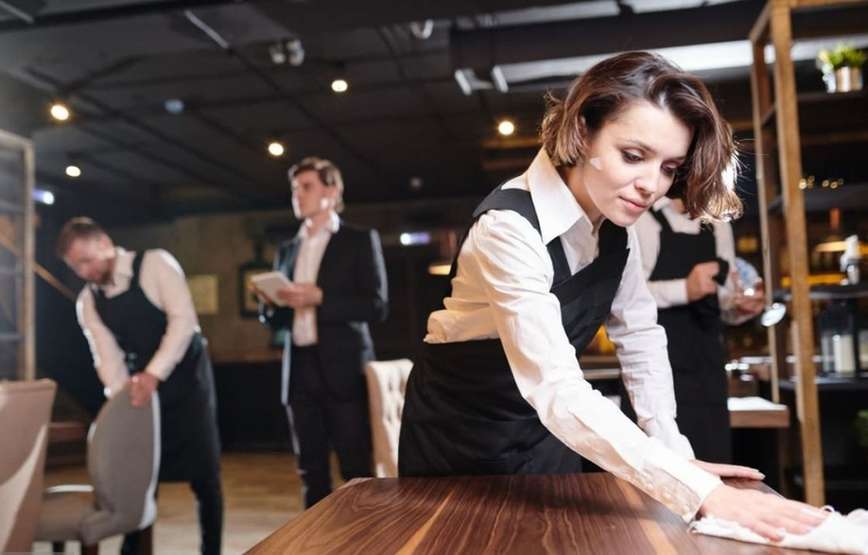
A busser is a front-of-house restaurant worker who keeps the dining room running smoothly by resetting tables, clearing used dishes, and supporting servers between guest seatings. This guide explains what bussers actually do during a shift, what they don’t do (a common mistake is assuming they’re “mini servers”), the skills that lead to more hours and better tips, and how the job can turn into a long-term hospitality career.
What a Busser Does (and What a Busser Is Not)
Bussers are the behind-the-scenes engine of the dining room. Their core purpose is simple: keep tables and guest areas clean, stocked, and ready so servers can focus on service and guests can be seated quickly. In many restaurants, a strong busser directly improves table turnover, guest satisfaction, and the server team’s ability to handle a busy rush.
A busser is not the same as a server, host, or dishwasher, even though the job overlaps with each. Bussers typically do not take orders, ring items into the POS, or handle payments unless the restaurant explicitly trains them for cross-coverage. They also usually don’t run the dish pit as their primary station—though they may help carry racks, scrape plates, or organize glassware to keep service moving.
Another misconception is that bussers only “clean tables.” In practice, they manage a constant stream of micro-tasks: pre-bussing (removing empty plates during the meal), resetting silverware, replenishing water, coordinating with servers about which tables are closing out, and keeping service stations stocked. The best bussers read the room and anticipate needs before anyone asks.
Depending on the concept, bussers may be called bus person, busboy, busgirl, or server assistant. The responsibilities are similar, but “server assistant” often implies slightly broader duties like food running, polishing glassware, or supporting multiple sections.
Busser Duties and Responsibilities
The duties and responsibilities of a busser can vary depending on the specific restaurant and its policies. However, a few tasks are generally associated with the role of a busser. These include:
- Setting tables: Bussers are responsible for setting tables with utensils, condiments, and other necessary items before guests arrive.
- Clearing tables: After guests have finished their meals, bussers will clear the tables of any dirty dishes, glasses, and silverware. They may also wipe down the tables to ensure they are clean and ready for the next group of diners.
- Refilling drinks: Bussers may be responsible for refilling drinks for diners throughout their meals. This may include water, soda, coffee, and other beverages.
- Assisting servers: Bussers may work closely with servers to assist with the food delivery and other tasks as needed.
- Maintaining a clean dining room: Bussers are responsible for ensuring that the dining room is always clean and organized. This may include sweeping and mopping the floor, wiping down tables and chairs, and restocking supplies as needed.
- Handling customer complaints: Bussers may be called upon to handle customer complaints or concerns in a professional manner, either by addressing the issue themselves or by escalating it to a manager or supervisor.
In a typical shift, these responsibilities show up in patterns. Early on, bussers often focus on opening side work (stocking, polishing, setting up bus tubs, checking sanitizer buckets). During peak hours, the priority becomes speed and organization: clearing and resetting tables quickly without disrupting guests, and keeping service stations stocked so servers don’t disappear to the back.
In many restaurants, bussers also help protect the guest experience in small, high-impact ways: removing clutter from the table, wiping crumbs between courses, swapping out dropped utensils, and quietly fixing wobbly tables or messy high chairs. These details rarely earn direct praise, but they strongly influence whether guests feel the restaurant is “clean” and “well-run.”
What a Typical Busser Shift Looks Like (Real-World Flow)
Understanding the rhythm of the job helps you decide if it fits your personality. Bussing is repetitive, but not monotonous—because the pace changes constantly. A slow lunch might require steady stocking and light cleaning, while a weekend dinner rush can feel like controlled chaos where priorities change minute to minute.
Most shifts start with setup and readiness. That can include checking floor sections, confirming table settings match the restaurant’s standard, and stocking items like napkins, ramekins, water pitchers, coffee supplies, or to-go containers. A busser who starts the shift organized usually has an easier time staying ahead during the rush.
During service, bussers alternate between pre-bussing and full resets. Pre-bussing means removing plates, glassware, and trash while guests are still seated—done politely and with awareness of timing. Full resets happen after guests leave: clear everything, wipe and sanitize, replace settings, and signal that the table is ready for seating.
At the end, bussers often handle closing side work. This may include breaking down stations, refilling for the next shift, sweeping and mopping assigned areas, consolidating trash, and returning items to storage. Many managers evaluate bussers heavily on closing consistency because it affects the next team’s start.
Busser Job Requirements
The job requirements for a busser can vary depending on the specific restaurant. However, a few skills and qualities are generally required for this position. These include:
- Physical stamina: Bussers are often on their feet for long periods of time and may be required to lift heavy objects, such as trays of dishes.
- Attention to detail: Bussers must pay close attention to their work, ensure that tables are set and cleared properly, and keep the dining room clean and organized.
- Customer service skills: Bussers should be friendly, courteous, and able to handle customer complaints or concerns professionally.
- Teamwork: Bussers must be able to work well with others, including servers, hosts, and other front-of-house staff.
- Flexibility: Bussers may be required to work evenings, weekends, and holidays and must be able to adapt to the changing needs of the restaurant.
- Prior experience: Not usually required for this role, but it can be beneficial. Some restaurants may require bussers to have a high school diploma or GED.
Beyond the basics, restaurants often look for bussers who can stay composed under pressure. Rush periods create noise, heat, and tight walkways, so employers value people who can move quickly without cutting corners or creating safety risks. Reliability matters too: in many dining rooms, one missing busser can slow the entire operation.
Some establishments also have minimum age requirements, especially if bussers clear alcohol glassware or work near bar service. Policies vary by location and company, so it’s worth asking during the interview what tasks are included and what training is provided.
Busser Skills (That Actually Make You Stand Out)
In addition to the job requirements listed above, there are a few specific skills that can be helpful for a busser to succeed in their role. These include:
- Time management: Bussers often have multiple tasks to complete and must be able to prioritize and manage their time effectively.
- Communication skills: Bussers should be able to communicate clearly and professionally with customers, servers, and other staff members.
- Organization skills: Bussers are responsible for maintaining a clean and organized dining room, which requires good organizational skills.
- Problem-solving skills: Bussers may be called upon to handle customer complaints or concerns and should be able to think on their feet and find solutions to problems as they arise.
- Basic math skills: Bussers may be responsible for handling cash and making changes, so basic math skills are important.
- Basic computer skills: Some restaurants may use point-of-sale (POS) systems or other computer programs, so basic computer skills can be helpful for bussers to have.
To stand out quickly, focus on “invisible” skills that managers notice: anticipation and section awareness. Anticipation means watching which tables are finishing dessert, which parties just got checks, and which server is slammed—then positioning yourself to reset the next table before the host needs it. Section awareness means knowing which tables belong to which server and avoiding accidental disruptions.
Another differentiator is cleanliness standards. Wiping a table isn’t enough if crumbs remain on chair seats, menus are sticky, or sanitizer solution isn’t maintained properly. Great bussers build a repeatable reset routine (clear, scrape, wipe, sanitize, reset, verify) so quality stays high even when the pace increases.
If you want to build transferable skills for other roles, consider developing cash-handling fundamentals and accountability habits. Even if you don’t touch payments often, understanding how restaurants track checks and tips helps you communicate better with servers and managers. For a deeper skill breakdown, see cash handling skills and how to develop them.
Busser Pay: Typical Hourly Rates, Tips, and What Affects Income
The salary of a busser varies depending on factors such as location, type of establishment, and experience. On average, busser wages range from minimum wage to $15 per hour, with tips sometimes supplementing their income.
While the pay may not be high, it can be a great starting point for those looking to enter the restaurant industry and gain experience in customer service and teamwork. With hard work and dedication, a busser can advance to higher positions within the restaurant, leading to better pay and career opportunities.
In many restaurants, bussers earn a base hourly wage plus a share of tips (often called tip-out or a tip pool). Tip structures vary widely: some places tip out bussers as a percentage of server sales, some use a pooled system across the front-of-house, and others pay a higher hourly rate with little or no tips.
Income is influenced by factors you can control and factors you can’t. You can control reliability, speed, and communication—these often lead to better sections to support, more shifts, and stronger tip-outs. You can’t control seasonality, the restaurant’s price point, or local labor laws, but you can choose environments where bussers are valued and trained.
| Factor | How it impacts busser earnings | Example |
|---|---|---|
| Restaurant type | Higher check averages often increase tip-outs | Fine dining vs. quick service |
| Tip structure | Determines whether tips are consistent or variable | Tip pool vs. percentage tip-out |
| Shift timing | Peak shifts usually generate more tips and hours | Weekend dinner vs. weekday afternoon |
| Experience and trust | Trusted bussers get scheduled more and placed on busy sections | Assigned to patio on a high-volume night |
| Cross-training | Extra skills can lead to higher base pay or hybrid roles | Busser + food runner duties |
| Local market and laws | Minimum wage rules and tip credit policies affect base pay | Different wage floors by city/state |
| Performance habits | Speed and quality influence server tip-out willingness and manager scheduling | Fast resets without missed silverware |
Busser Work Environment: Pace, Pressure, and Safety
There are a few general characteristics that may describe the work environment for a busser.
- Busy: Bussers often work in fast-paced environments, with many tasks to complete in a short amount of time.
- Customer-facing: Bussers work in the front-of-house and may interact with customers on a regular basis.
- Team-oriented: Bussers often work closely with servers, hosts, and other front-of-house staff and may be part of a larger team.
- Flexible hours: Bussers may be required to work evenings, weekends, and holidays and may have varying schedules from week to week.
- Physical demands: Bussers are often on their feet for long periods of time and may be required to lift heavy objects, such as trays of dishes.
- High-stress: The restaurant industry can be high-stress, and bussers may be under pressure to meet the needs of customers and keep the dining room running smoothly.
Because bussers move constantly through tight spaces, safety and body mechanics matter. Slips happen from wet floors, dropped ice, or spilled drinks; burns can happen near coffee stations or hot plates; and repetitive lifting can strain wrists and backs. A professional busser uses non-slip shoes, keeps loads balanced, and avoids stacking glassware in unsafe ways.
Expect frequent coordination with the host stand and server team. A busser might be asked to prioritize a specific table for a waiting party, help reset a large-top, or clear a section quickly for a reservation wave. The best working environments are the ones with clear communication: who “owns” which tasks, how to call for help, and what “ready” means.
If you’re comparing hospitality roles, bussing is often more physically intense than cashiering but may offer better exposure to the service flow. If you’re curious about another entry-level role with different demands, compare with Cashier responsibilities and skills.
Busser Trends (How the Role Is Evolving)
There are a few trends that may be affecting the role of the busser in the restaurant industry:
- Increased focus on customer service: With the rise of online reviews and social media, restaurants are more important than ever to provide excellent customer service. As a result, bussers may be expected to go above and beyond to ensure that customers have a pleasant dining experience.
- Technology integration: Many restaurants are using technology to streamline their operations, and bussers may be expected to be proficient in using point-of-sale systems, ordering systems, and other computer programs.
- Increased focus on sustainability: Some restaurants are implementing sustainability practices, such as reducing food waste and using environmentally-friendly products. Bussers may be expected to help implement and adhere to these practices.
- Increased focus on health and wellness: As more people become concerned about their health, some restaurants offer healthier menu options and use healthier ingredients. Bussers may be expected to be familiar with these options and be able to assist customers with their orders.
- Increased focus on diversity and inclusion: Many restaurants are trying to create a diverse and inclusive work environment. As a result, bussers may be expected to be respectful and inclusive of all customers and coworkers.
In practice, many restaurants are also tightening standards around sanitation consistency and allergen awareness. Bussers may be asked to follow specific cleaning sequences, use labeled sanitizer solutions, and keep separate cloths or bins for certain tasks. Even when bussers aren’t handling food directly, their work affects cross-contact risk through shared surfaces like tables, chairs, booster seats, and menus.
Another ongoing shift is the rise of hybrid support roles. Some teams combine bussing with food running, expo support, or beverage refills to reduce handoffs and speed up table turns. If you like variety, this can be a positive—just confirm expectations during hiring so the workload matches the pay and tip structure.
How to Become a Busser (Step-by-Step)
There are a few steps you can take to become a busser:
- Research the role: Familiarize yourself with the duties and responsibilities of a busser, as well as the skills and qualities that are typically required for the position.
- Get experience: While prior experience is not always required to become a busser, it can be beneficial. Consider applying for internships or entry-level positions in the restaurant industry to gain some experience.
- Apply for busser positions: Look for open busser positions at restaurants in your area and apply. You may need to submit a resume and cover letter and be asked to attend an interview.
- Get trained: Once you are hired as a busser, you will likely receive training on the specific policies and procedures of the restaurant. Be sure to pay attention and ask questions during this training so you can learn as much as possible.
- Demonstrate your skills: To excel in your role as a busser, demonstrate your attention to detail, customer service skills, and ability to work well with others.
- Consider advancing: If you are interested in advancing in the restaurant industry, consider seeking additional training and education, and look for opportunities to take on more responsibility within your organization. This can help you build your skills and experience and increase your chances of moving up to a higher-level position.
To improve your odds of getting hired with no experience, show that you understand what the job really is: speed, cleanliness, teamwork, and professionalism. A short resume that highlights reliability (sports, volunteering, school attendance, other jobs) can be more persuasive than trying to “sound like a server.” Managers often hire bussers based on attitude and consistency.
When applying, target restaurants that match your goals. If you want to become a server, choose a place that promotes from within and has clear training steps. If you want stable hours, look for higher-volume concepts with consistent traffic. If you want to learn fine-dining standards (polishing, silent service, table marking), apply to upscale restaurants where support staff is trained carefully.
Advancement Prospects: From Busser to Server, Bartender, or Manager
While there is potential for advancement for bussers, it is important to note that this can vary depending on the specific restaurant and its policies. Some bussers may choose to stay in this role and build their skills and experience within the restaurant industry. Others may be interested in pursuing advancement to higher-level positions.
One potential path for advancement for bussers is to become a server. Servers take orders, serve food and drinks, and handle customer payments. To become a server, you may need to have prior experience as a busser and demonstrate strong customer service skills.
Another potential path for advancement is to become a supervisor or manager. Supervisors and managers are responsible for overseeing the work of front-of-house staff, including bussers and servers, and may be responsible for tasks such as scheduling, training, and budgeting. To become a supervisor or manager, you may need to have prior experience in the restaurant industry and demonstrate leadership skills.
It is worth noting that advancement in the restaurant industry can be competitive and may require further education or training. If you are interested in pursuing advancement, it can be helpful to seek out opportunities to learn new skills and gain experience and to be proactive in seeking out leadership roles.
A practical way to speed up advancement is to become the person who solves problems without drama. Managers notice bussers who keep service stations stocked, communicate clearly, and avoid conflicts during busy shifts. If servers trust you, they’ll advocate for you when server openings appear—and they’ll often share tips and training informally.
Ask for cross-training in a structured way. For example: learn food running first (table numbers, seat positions, auctioning food), then learn basic hosting (rotation, waitlist quotes), then learn server steps (greeting, order taking, POS, check handling). If your long-term plan includes bar work, learning glassware standards and bar-side organization can also help; see Bartender for a related career path.
Common Mistakes and How to Avoid Them (Manager-Level Advice)
Many new bussers work hard but still struggle because they focus on the wrong priorities. One common mistake is clearing a table too early (making guests feel rushed) or too late (slowing down seating). The fix is to watch for natural cues: finished plates pushed inward, checks placed, guests standing up, or the server signaling that the table is closing.
Another frequent issue is messy, inefficient bussing. Carrying too many items at once, stacking glassware unsafely, or mixing silverware with food waste can cause breakage and slow the dish flow. Use bus tubs strategically, scrape plates consistently, and keep glassware stable and separated when possible.
Communication mistakes can also create friction. Bussers sometimes reset a table without telling the host, or clear items a server still needs (like a wine bottle for presentation). A simple habit helps: confirm table status with the server when unsure, and give the host a clear “Table 12 is clean and set” signal according to the restaurant’s process.
Finally, avoid disappearing. Even if you’re doing something important in the back, the dining room can fall behind quickly. If you need to step away (trash run, dish drop, restock), do it fast and return to the floor. Managers schedule bussers who stay visible, responsive, and calm.
Busser Job Description Example (Customizable)
Here is an example job description for a busser position:
Job Title: Busser
Job Description:
We are seeking a friendly and organized busser to join our front-of-house team at [Restaurant Name]. As a busser, you will be responsible for maintaining a clean and organized dining room, and working closely with servers to ensure that customers have a pleasant and enjoyable dining experience.
Responsibilities:
- Set tables with utensils, condiments, and other necessary items before guests arrive.
- Clear tables of dirty dishes, glasses, and silverware after guests have finished their meals.
- Wipe down tables to ensure they are clean and ready for the next group of diners.
- Refill drinks for diners throughout their meals, including water, soda, coffee, and other beverages.
- Assist servers with food delivery and other tasks as needed.
- Maintain a clean and organized dining room by sweeping and mopping the floor, wiping down tables and chairs, and restocking supplies as needed.
- Handle customer complaints or concerns in a professional manner, either by addressing the issue yourself or by escalating it to a manager or supervisor.
Requirements:
- Physical stamina: Bussers are often on their feet for long periods of time and may be required to lift heavy objects, such as trays of dishes.
- Attention to detail: Bussers must pay close attention to their work, ensure that tables are set and cleared properly and that the dining room is kept clean and organized.
- Customer service skills: Bussers should be friendly, courteous, and able to handle customer complaints or concerns in a professional manner.
- Teamwork: Bussers must be able to work well with others, including servers, hosts, and other front-of-house staff.
- Flexibility: Bussers may be required to work evenings, weekends, and holidays and must be able to adapt to the changing needs of the restaurant.
- Prior experience is not required, but it can be beneficial. A high school diploma or GED is preferred.
We offer competitive pay and the opportunity to grow and advance within our organization. If you are passionate about the restaurant industry and have a strong work ethic, we encourage you to apply for this exciting opportunity.
Similar Jobs
FAQ: Busser Job Questions (People Also Ask)
What does a busser do in a restaurant?
A busser supports the front-of-house by clearing and resetting tables, maintaining cleanliness in guest areas, restocking service stations, and assisting servers so the dining room can seat guests quickly and run smoothly.
Is a busser the same as a food runner?
No. A busser primarily clears and resets tables and maintains dining room cleanliness, while a food runner primarily delivers plated food from the kitchen to the correct table and seat positions; some restaurants combine the roles, but the core focus differs.
Do bussers get tips?
Many bussers receive tips through a tip-out or tip pool, but the exact system varies by restaurant; some bussers earn mostly hourly pay, while others earn hourly pay plus a consistent share of front-of-house tips.
Do you need experience to be a busser?
Busser jobs often require little or no prior experience, because many restaurants train new hires on table reset standards, sanitation routines, and service flow; reliability, stamina, and teamwork usually matter more than past restaurant work.
What skills make a busser successful?
The most important busser skills are speed with consistency, attention to cleanliness details, strong communication with servers and hosts, safe lifting and carrying, and the ability to anticipate which tables will need to be reset next.
What are common busser interview questions?
Common busser interview questions focus on availability, handling fast-paced work, teamwork, and cleanliness standards, such as “How do you prioritize tasks during a rush?” and “How do you handle feedback from servers or managers?”
How do bussers move up to server or bartender?
Bussers often advance by becoming consistently reliable, learning table numbers and service steps, asking for cross-training (food running, hosting, POS basics), and demonstrating guest-focused professionalism that managers trust in higher-responsibility roles.
What’s the difference between a busser and a dishwasher?
A busser works primarily in the dining room clearing and resetting tables and supporting servers, while a dishwasher works primarily in the back washing dishes, glassware, and utensils; bussers may drop dishes to the pit, but dishwashing is a separate role.
Bottom line: bussing is one of the fastest ways to learn how restaurants operate under pressure. If you like staying active, working as part of a team, and improving through repetition, it can be a strong entry point with clear paths to higher-paying front-of-house roles.